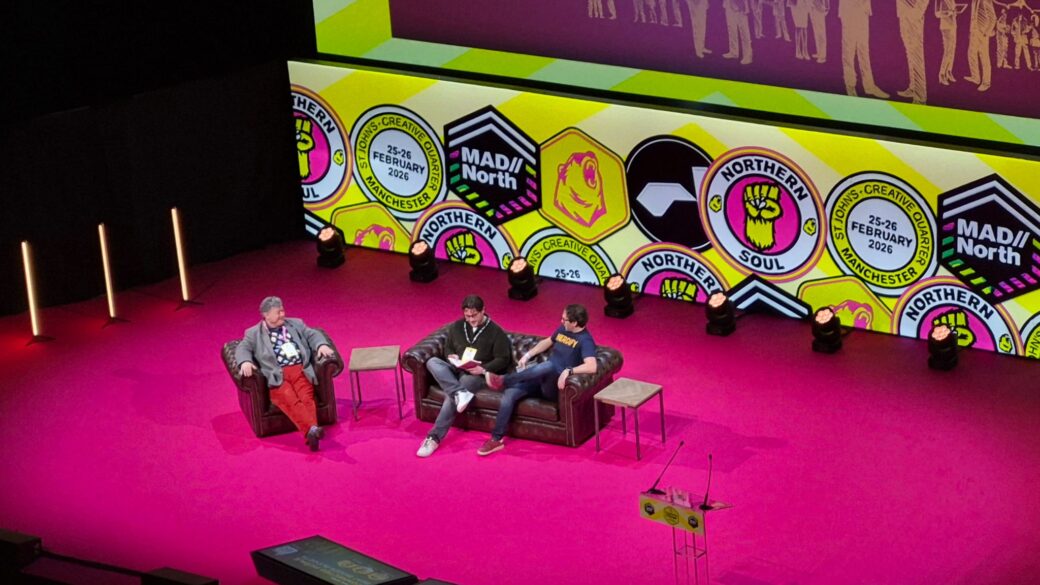
Last month at MadNorth 26 in Manchester, I had the pleasure of sitting in on a Leaders Lab session with the legendary Rory Sutherland. As always, Rory didn’t just talk about ads; he talked about the “Gems” of human nature that most boardrooms completely ignore in favor of spreadsheets.
In a world obsessed with AI and immediate ROI, the conversation was a refreshing reminder: If you only look at the numbers, you’re missing the humans.
Here are the three biggest takeaways for every marketing leader today.
1. The “Gails Coffee” Effect: Why We Follow the Herd
Rory shared a brilliant observation about Gail’s Bakery. Their queuing system is objectively “inefficient”—you wait, you stare at cakes, you order, then you stand around.
But as Rory pointed out, the queue is the marketing. Humans are evolved herd animals. Evolutionarily, if everyone is eating the purple berries and nobody is eating the yellow ones, you eat the purple ones. In marketing, we often try to sell “features and benefits” (the yellow berries), but we forget that:
- Social proof is hardware, not software. It’s a feeling of safety, not a rational calculation.
- Visible adoption matters. A product that looks popular becomes popular.
- Contagion Value vs. ROI. Rory argued that selling 5 solar panels on one street is more valuable than selling 15 panels spread across a county. Why? Because of complex contagion—the multiple exposures needed to make a new behavior feel “normal.”
2. The Danger of “Doorman Automation”
As we rush to integrate AI, Rory issued a stern warning against the “Dorman Fallacy.” Imagine a hotel replaces its doorman with an automatic door to save costs. On paper, the “function” (opening the door) is still being met. But 6 months later, the hotel’s occupancy drops. Why? Because the doorman provided security, recognition, status, and human warmth.
“AI has the potential to make human experiences better… but if you sell it to business on the basis of cost production (getting rid of people), you’re ignoring the value creation.”
Rory said, AI should be used for Value On, not Money Off. The goal isn’t to do the “wrong thing faster,” but to use technology to discover missing psychological dimensions that spreadsheets can’t see.
And honestly (and I have spoken about this before) I couldn’t agree more!
3. Fighting “Quantification Bias”
One of the “most profound”gems” Rory dropped that really stood out to me was about Wet Bulb Temperature. In climate science, most “experts” track “dry” temperature because it’s easy to measure. But “wet bulb” temperature (which accounts for humidity) is what actually determines if a human can survive.
Business is the same. We optimize for what is easy to measure (clicks, immediate sales, CPC) and ignore what actually matters (fairness, regret, status, and long-term advocacy).
Rory’s advice? Stop trying to win arguments with numbers alone.
- The person with the numbers (Finance) usually has a veto.
- But the person with the “Human Lens” (Marketing) is the only one who can prevent “logical” decisions from being “human” disasters. (Just look at the Concorde—an engineering marvel that failed because it ignored how humans actually sleep and travel). There was an explanation that I didnt fully grasp about it being great in one directs (as You arrive an hour earlier than you left, ready for the day ahead, but coming back you spend an extra day waiting for the 2nd flight of the day – and arrive a day leter and tired… or something?)
The Bottom Line
The greatest threat to our industry isn’t AI—it’s the low regard for marketing mindset in the decision-making framework.
As leaders, our job isn’t just to run campaigns. It’s to be the “Chief Advocacy Officers” who remind the organization that humans don’t make decisions in a vacuum. We make them based on what our neighbors do, how we feel when we walk into a room, and whether a brand makes us feel like “one of us.”
Let’s stop being “predictive texting on steroids” and start asking the philosophical questions that AI can’t.
In a later session, Kenyatte Nelson, Chief Membership and Customer Officer at Co-Op answered a question from the audience about how to manage junior employees and the risks now that they are masking or skipping real foundational marketing skills in turn for AI actually doing their work for them.
It’s a future problem that is going to hit hard, when these “junior” marketers become the next generation of markketing leaders…
But the star of the show was Bez