June 26, 2026
There is an old startup adage: if your idea is okay, you’ll have to force people to pay attention. If your idea is great, it will be copied immediately.
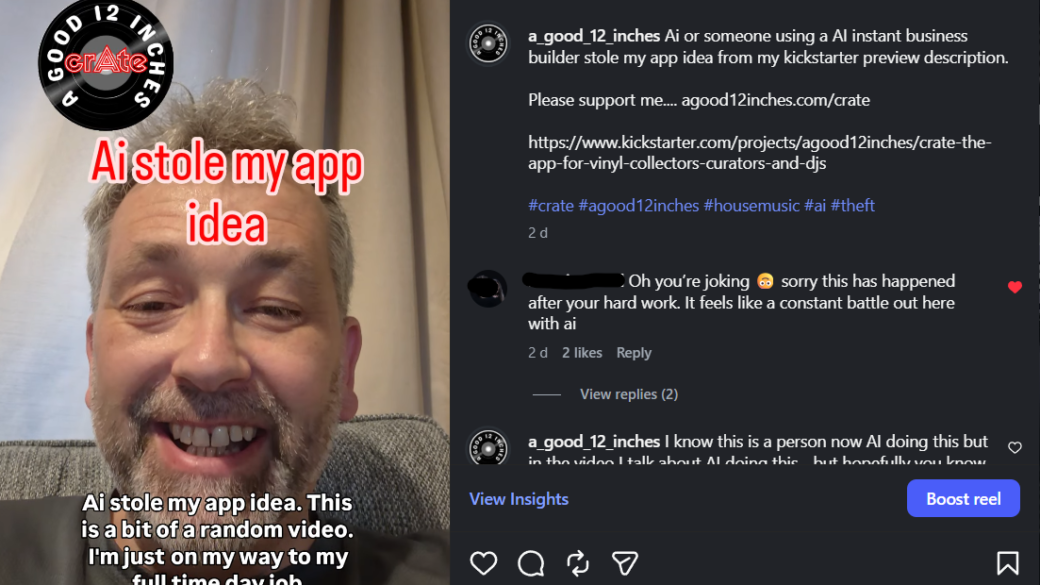
I just didn’t expect it to happen before the app was released or before I even hit the “Launch” button on my Kickstarter page.
On Tuesday, I put up the Kickstarter preview page for crAte, the native mobile app I’ve been building for vinyl DJs, collectors, and curators. The pitch was simple: an app that bridges the gap between physical records and digitally managed sets. You scan a physical record, the app looks up the barcode, Cat#, or uses AI to read the label. It allows you to create virtual gig bags so you can group records together in set lists without moving them on the shelf and breaking your cataloguing system… and it instantly pulls the YouTube audio so you can preview tracks and build those digital gig bags from the couch without digging in your shelves.
I kept the technical details vague on the preview page to build curiosity. But apparently, it was just enough information for someone to feed into an AI website builder. That night I went to sleep excitied at the possibilities to speed up development, that the Kickstarter fundraiser might bring…
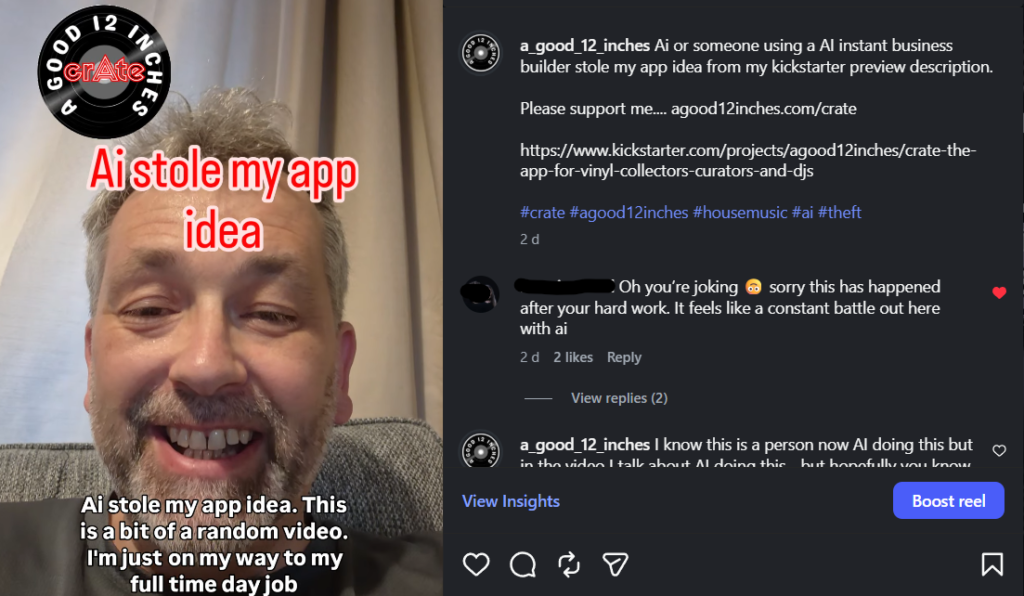
The next morning, when I woke up, I saw an advert on Instagram for a digital curation app called “crate”… there it was… a clone live on the web for a £4.99 subscription.
The AI Web Clone vs. The Native Reality
Someone prompted an AI development tool to scrape my Kickstarter description and spit out a responsive website. They even ripped off the name.
Because they didn’t know how I was building the app, the AI took the path of least resistance. The clone doesn’t have a camera scanner. It doesn’t read record labels. Instead, it features a “Sign in with Discogs” button that imports your collection data and pulls up YouTube videos in a browser. (Not a bad feature to be honest…)
It is a functional utility, but it completely misses the mark on what I am trying to build.
| Feature | The AI Clone | The Real crAte |
|---|---|---|
| Platform | Responsive Website | Native Mobile App |
| Data Entry | Discogs API import only | Live Camera OCR Scanning |
| Environment | Desktop/Browser focused | Built for dark clubs and studios |
| The Vibe | Souless generic AI tool | Tactile digital crate-digging |
The Ultimate Market Validation
Initially, seeing a knockoff of my hard work is incredibly frustrating. But once the dust settled, I realised this is the most aggressive form of market validation a founder could ask for.
Someone saw the crAte Kickstarter, recognised that the pain point for vinyl DJs was real and lucrative, and immediately tried to beat me to market using automated tools. They proved the demand exists.
More importantly, they exposed the fragility of relying purely on AI to generate a product without understanding the user. A Discogs web importer is just a database viewer. Real DJs interact with physical media. You need to be able to pull a scuffed white label out of a dusty crate, point your phone at it in dim lighting, and instantly hear what’s on the record. A web browser can’t replicate that tactile workflow.
The Judo Move
I’ll admit, their one human contribution—the Discogs API import—is a solid feature for onboarding bulk collections. It’s a good idea.
So good, in fact, that I am officially making Discogs OAuth Integration a stretch goal for the real crAte Kickstarter campaign. We are absorbing the clone’s only party trick and baking it into the actual native app, right alongside the Gemini AI scanning engine.
AI can write code in seconds based on a vague prompt, but it can’t replicate the culture, the passion, or the actual workflow of a DJ. The real crAte is coming to Kickstarter soon, built specifically for the people who actually touch the vinyl.
If you are interested, you can register here Check out the latest updates!